
The battle of pressures at the heart of the industry
At first glance, compressors and boosters may seem similar: both are devices that compress air or gas. However, when we dive into the details, their differences are like the distinction between two champions with different fighting styles—one versatile and the other a high-pressure specialist.
🌀 Conventional Compressor: The Foundation of Compression
Conventional compressors, such as piston or screw models, draw air directly from the environment and compress it to a specified pressure. This pressure is typically between 7 and 15 bar and is suitable for general applications like:
- Pneumatic tools in workshops
- Ventilation and cooling systems
- Dentistry and general medicine
- Industrial painting
The simple design, low maintenance costs, and variety of models have made conventional compressors widely used in many industries.
🚀Piston Booster: The High-Pressure Specialist
Boosters, unlike regular compressors, receive already compressed air or gas and increase its pressure in multiple stages. These devices are designed to reach high pressures (up to 200 or even 3000 psi) and are used in industries such as:
- Filling scuba or firefighting cylinders
- Gas injection in oil and gas pipelines
- Production of high-purity nitrogen or oxygen
- Pressure testing in industrial equipment
Boosters typically feature inter-stage coolers to prevent overheating and maximize efficiency.
⚖️ Technical and Application Comparison
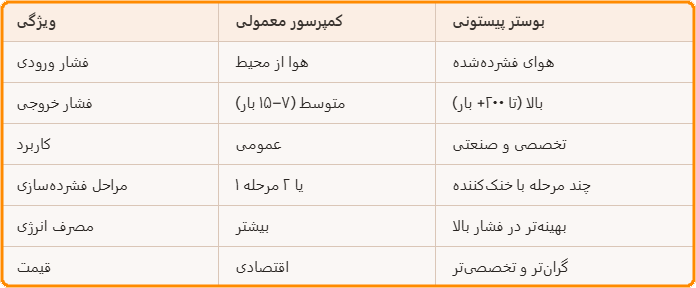
🎯 Conclusion: Choose Based on Need, Not Similarity
If you’re looking for basic air compression for general purposes, a standard compressor is the best choice. However, if you need high pressure and precise performance, such as for filling breathing cylinders or injecting gas in industrial pipelines, a piston booster is the smarter choice.